Cron: Scalable Architectures EP
Reissue of mid-90s Todd Sines prod. Detroit style Electro explorations
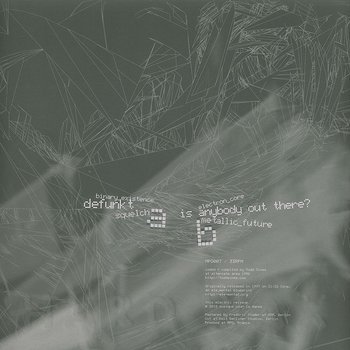
- A1 Binary Existence
- A2 Defunkt
- A3 Squelch
- B1 Electron Core
- B2 Is Anybody Out There?
- B3 Metallic Future
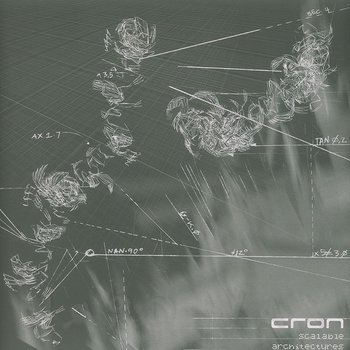
"The software utility Cron is a time-based job scheduler in Unix-like computer operating systems. People who set up and maintain software environments use cronto schedule jobs (commands or shell scripts) to run periodically at fixed times, dates, or intervals. "I had an early affinity for electro: Art of Noise, Yello, Whodini, Newcleus, the Beat Street soundtrack, etc. I breakdanced to Herbie Hancock’s Rockit at my dad’s wedding in 1983. Finally heard Kraftwerk’s Electric Cafe in high school, which deeply influenced me. I was fascinated by Unix at the time of writing the cron and .xtrak material [1994-1997], in addition to how instant communication and gratification, via the internet, would end up changing everything. I first got online in 1992, and we were connecting people to come to our ele_mental events with flyers, posters, word of mouth, voicemail, but also, the *internet*, something of a novelty at the time. We would set up a VT100 terminal in May of 1993, allowing the event attendees to talk to each other via “vrave”, created by Apache’s Brian Behlendorf, which allowed for realtime group chats around the world. In meaning, whereas .xtrak was a play upon the .xterm GUI terminal application for Unix’s X windows, cron was a task scheduler, which you could sequence events, say, a backup of the daily log, etc. and it would execute tasks at a regular Interval [our new postpunk / industrial / EBM project]. Throughout my early gear collecting at second hand shops in Midwestern Ohio, l found a Synton vocoder SPX216, Yamaha DX100, and Arp Avatar, and started working on some material that wasn’t .xtrak, Enhanced, or “Todd Sines” — it had it’s own vibe. Cron was born through my exploration of these machines, but the visual presentation of the EP was also equally important. I started to create 3d objects using L-systems, a mathematical function that uses recursion to iterate a formula, used often to model 3d trees and vegetation. Intentionally misused, I created these unique 3d forms that would become the artwork of “scalable architectures”, another play upon computer network / system technology that can grow as the systems' needs increased."